March 27, 2026, found me in Pelham, Alabama — playing the National Women’s Singles and Doubles Championships. My doubles partner and I are currently the number 1 women’s 75 team in the country. While we enjoy playing together and have solid results, we take each match seriously and play with intent.
In the finals, our opponents were a doubles team with a solid player who hit with 2 hands on both sides and her partner, who hit high lobs nearly every shot except her return of serve. We knew we could be in for a long fight, and we did not want that.
Trying to outhit them or rush to the net was not the game plan. As the match started, I was at net, and my partner served and volleyed. The lobber hit a regular return, but followed up the next ball with a very high lob over my head. Running back to retrieve this was definitely not high on a list of things I wanted to do, and since my partner had just run to the net after her serve, she was definitely not running back! So … let’s consider options when facing a lobber.
Lobs are only lobs if there is someone to lob over. If there is no one to lob over, these annoying straight-up-in-the-air balls become potential swinging volleys or backing-up groundstrokes. I had watched this same woman, the lobber, play a three-and-a-half-hour match the year prior! She was content to play no-miss, high-ball tennis. No strategy … just no miss. Not on my list of positives.
As my partner served, our first decision was to have me stay back around the baseline, which allowed her to move in to volley without feeling she might have to turn around and run back to cover the ball over my head.
So one option when dealing with a lobber: plan to stay back if your partner wants to go in. Or stay back and send her in at the right time. What’s the right time? Moving in is best when you’ve just served or when you and your partner have created a situation where the opponent is on defense or in a less comfortable position due to your shot selection.
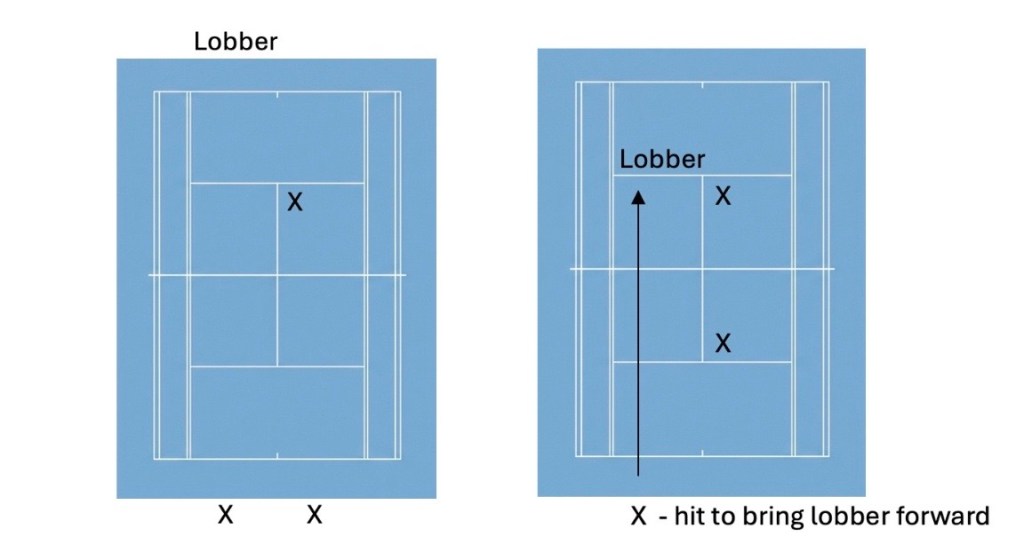
Your goal is to create opportunity for your side. Let’s look at an example from our match. Knowing we wanted to have my partner go to net, as the comfortable baseliner on our team my strategy was to hit not more than two of these high balls before slicing the ball down so that it landed around the service line. This not only allowed my partner to go to net, it also effectively brought the lobber to midcourt, where she was both unhappy and unable to hit the sky high balls. She was also in an uncomfortable area of the court. The next ball that I hit was then a hard drive, catching her as she retreated and allowing my partner to hover at the net to get a play.
When it comes to considering shot selection when playing against a “no miss” high ball lobber, do not make the mistake of trying to hit solid deep groundstrokes. This will only tire you out, prolonging the agony and leading to frustration. Going harder, going deeper must be substituted by hitting angles, bringing the lobber forward (not necessarily with a drop shot, a shorter sliced low ball is also a good option), and creating openings in the court. Do not allow the lobber to patrol the baseline – their comfort zone.
In general, lobbers do not have strong serves. Their serves are merely point starters. This is a good time to use the drop shot instead of power.
So what about the lobber’s partner? Well maybe instead of allowing the lobber to take over both the strategy and the match, it might be better just to isolate her partner. Forget the strategy of creating the opening and just overplay her partner. Could be a better choice.
We won the National Claycourts in the finals 6-3, 6-0 — and avoided a frustrating, extra long, lobbing match!
Share this page with your tennis friends!
https://judydixontennis.com/strategyandtechnique/overcoming-the-high-ball-lobber/
To receive future Tennis Strategy & Technique posts in your inbox:
SUBSCRIBE to Judy’s YOUR AD! newsletter
 Judy Dixon